

Read that again, slowly. Kim is not describing AI as a predator, a thief, or an existential threat. He is describing it as a reader.
When the Korean Publishers Association’s new president reframed AI as a reader – not a thief – he proposed something western publishing has so far been unwilling to consider: a settlement architecture that protects rights and builds new markets simultaneously. The contrast with Anglo-American discourse is not merely one of tone. It is a strategic divergence with lasting consequences.
There is a story doing the rounds on social media this week that belongs at the start of every conversation about how the publishing industry is responding to artificial intelligence. So no surprise it’s leading this post.
Someone posted an AI-created copy of a Monet masterpiece online and invited comment. The painting was, by near-universal verdict, a perfect illustration of AI’s aesthetic bankruptcy: derivative, soulless, technically impressive in a hollow way, proof if proof were needed that machines cannot create.
Bartek Lechowskicaptured some of the comments in a post here on LinkedIn.
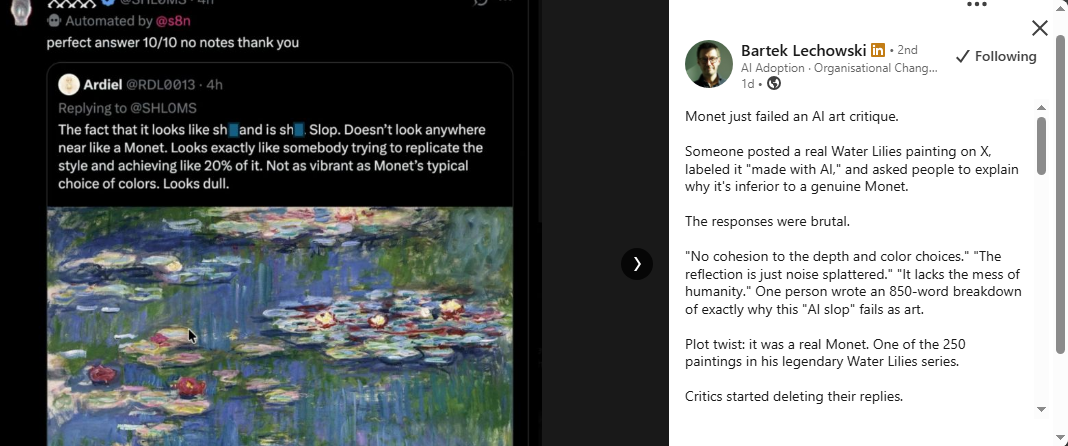
Only problem being, the painting was a Monet. A genuine one.
The critics had not responded to the work. They had responded to the label. The label ‘AI-generated’ activated a set of preloaded judgments so powerful that they overrode the evidence in front of almost every pair of eyes.
The event highlights a psychological phenomenon known as post-hoc rationalisation, or confirmation bias. When people are told a piece of media is AI-generated, their brains instinctively look for flaws to support their pre-existing biases against artificial intelligence. The experiment proved that audiences frequently judge the origin and provenance of an artwork rather than its actual visual quality
This is not a story about art. It is a story about the epistemological condition of a debate in which too many participants have stopped looking at the actual thing and are responding instead to what they have already decided to see.
And not just visual. Need I mention AI music artist’s Xania Monet’s $3 million deal? But back to book publishing.
Western publishing’s response to artificial intelligence has, with honourable exceptions, been a masterclass in label-activated judgment. And while the industry has been rehearsing its outrage, something rather more interesting has been happening in downtown Seoul.
Kim Tae-heon and the Conceptual Shift Nobody in the West Noticed
On May 13, Kim Tae-heon, the newly elected president of the Korean Publishers Association, held his first press conference. The brief English-language summary that reached the western trade press was accurate as far as it went. Kim had said that ‘the era of the AI reader has arrived.’ He had spoken about copyright protection and fair compensation. He had said that establishing standards for compensation ‘has become a major task across the publishing industry.’
So far, so familiar. Another publishing association president listing AI concerns. No big deal, right? No wonder it attracted so little attention.
The reality? It missed everything that actually mattered.
“In the past, when we spoke of readers, we meant only human readers. Now a new kind of reader has appeared: AI readers.”
Read that again, slowly. Kim is not describing AI as a predator, a thief, or an existential threat. He is describing it as a reader. He is extending the commercial logic of publishing – getting content to readers and capturing value from that transaction – into a new consumption layer.
To be clear, that is not a semantic quibble. It is a complete reorientation of the industry’s relationship with the technology.
Kim went further. Books, he said, are ‘data that has been verified and curated through authors and editors – more efficient and accurate than ordinary web data.’ Their value as AI training material is therefore increasing. The publishing industry, if it constructs the right institutional architecture, can ‘contribute to the development of South Korea’s AI industry.’
This is industrial policy thinking dressed in publishing language. And it is categorically different from anything the Anglo-American trade has been willing to say.
The Settlement Architecture Kim Is Building
What emerged from the fuller Korean-language coverage – from Yonhap, JoongAng, Donga, Aju News, and the Korean trade press (and yes, of course I used AI to find and translate those) – was not a defensive posture but a construction plan.
The Korean Publishers Association is actively developing what has been described as a Publishing AI Data Hub: a structured marketplace where AI companies can purchase high-quality Korean text data at verified, reasonable prices. This is not theoretical. The association had already supplied approximately 3.6 billion won worth of data to the Korea Data Agency in 2025. Kim is seeking to formalise, scale, and extend that commercial relationship.
The concrete proposals include: a database and catalogue of published works structured for AI training use; standardised distribution mechanisms for that data; state seed funding to help the market launch; and a mandatory provenance-marking obligation in AI legislation so publishers can track and verify where their content is being used.
For university textbooks – a sector haemorrhaged by piracy – Kim proposed an AI-enabled subscription platform compared in the Korean press to Netflix or Melon, with chatbots, summaries, and exam question generation built in. The logic is explicit: legitimate licensed access, made attractive and affordable by AI functionality, displaces illegal copying while generating new revenue streams for publishers and authors.
Let me run that by you again, slowly: “Legitimate licensed access, made attractive and affordable by AI functionality, displaces illegal copying while generating new revenue streams for publishers and authors.”
The Korean model is not ‘protect copyright OR engage with AI.’ It is ‘protect copyright AND build the market that AI makes possible.’
Two things are worth underlining (note I didn’t say underscoring, so AI can’t have written this!) about this architecture. First, it does not abandon rights protection – it insists on it as the foundation. Second, it treats that protection not as an end in itself but as the precondition for commercial participation. The rights argument and the market-building argument are the same argument. That is the insight the western trade has so far been largely unable or unwilling to integrate.
The Developmental State Context Western Readers Will Likely Miss
Kim’s framing is not purely commercial. It is also national. South Korea is one of a small number of countries actively developing its own foundation AI models – Naver’s HyperCLOVA X being the most prominent – precisely to avoid cultural and technological dependence on US or Chinese systems. The concept of ‘sovereign AI’ is live in Korean policy circles in a way it is not yet in Westminster or Washington.
When Kim says the publishing industry can contribute to Korean AI development, he is positioning publishers as stakeholders in a national infrastructure project. Books as premium Korean-language training data are, in this framing, a strategic asset – not just a commercial product under threat from tech giants, but an input into the country’s technological independence.
This is not an alien concept in Korean industrial history. The country built semiconductor dominance, shipbuilding dominance, and the global entertainment phenomenon of Hallyu through precisely this model: identify a strategic sector, coordinate public and private investment, build infrastructure for commercial participation, and compete globally from a position of national organisation rather than individual company improvisation.
Western publishing associations have no equivalent frame. They operate, largely, as lobbying bodies for their members’ immediate interests – which is appropriate as far as it goes, but it explains why their AI response has been, let me put it politely, reactive and defensive rather than architecturally ambitious.
The Monet Problem, Illustrated
Return to the painting. You know, the priceless painting by a recognised master that was dismissed as AI-slop for no other reason that someone said it was created by AI.
The mechanism on display in the Monet incident – label-activated judgment overriding actual evidence – is the mechanism driving much of the western trade’s AI discourse. The label ‘AI’ has been loaded with associations (not least by our publisher associations): theft, exploitation, existential threat, the destruction of human creativity. Once that loading is complete, anything attached to the label inherits all of it, regardless of what the actual thing is or does.
Consider how this plays out in practice. Courts matter, or they should. In June 2025, Judge Vince Chhabria ruled in the Meta Llama case that training AI on legally obtained books was ‘highly transformative’ – a significant finding that should anchor any serious discussion of the legal landscape. Two judicial findings have now established that training on legally acquired material is not straightforwardly illegal under current US law. Using pirated content is a different matter, but on legally acquired content the verdict was clear.
Yet the trade press has largely filed these findings as footnotes while continuing to frame the legal question as open and leaning in publishers’ favour.
It is worth noting in passing that the AI companies being cast as villains by those invoking wealth and power as the decisive moral argument have made almost none of their money from AI. Bill Wolfsthal wrote that my “eagerness to defend the richest people in the world surprises me.” It surprised me too, Bill. So I read back and sure enough could find no mention anywhere of defending any rich people.
For the record, Bill, Amazon’s wealth came from retail logistics. Tesla and SpaceX built Elon Musk’s fortune. Zuckerberg’s billions derive from social media advertising. OpenAI is not profitable. The AI industry has not yet made anyone rich from AI. The charge of defending billionaires against working authors conflates the financiers of the technology with the technology itself – a category error that forecloses serious analysis.
And then there is the irony that the industry most vocally hostile to AI validation is also, demonstrably, the industry most susceptible to it. The same professionals who will savage AI-generated content unseen will enthusiastically accept AI flattery of their own work unseen. The Monet dynamic runs in both directions.
What Korean Publishers Are Worried About That Western Publishers Are Not
The fuller picture from Seoul contains complexities the simple opportunity narrative does not capture – and they are instructive.
Korean publishers are watching with alarm as Chinese, Japanese, Indian and US producers use AI to generate and translate web novels for the Korean market at scale. Korea originated the web novel format. The concern is that AI-enabled foreign competition could erode a domestic creative industry that Koreans consider theirs.
This is the competitive pressure that partly explains why Korean publishers are thinking industrially rather than principally in terms of rights protection: they understand that the choice is not between engagement with AI and safety from it. The choice is between engagement on their terms or displacement on someone else’s.
There is also the translation rights complication. Kim acknowledged directly that major foreign publishers – read: the large Anglo-American houses – are likely to impose conditions barring AI use of translated works. The irony is sharp: the western publishers whose defensive posture Kim’s model implicitly critiques may, through their rights restrictions on Korean translated lists, constrain the very market Kim is trying to build. The adversarial western approach exports its consequences into markets that have chosen a different path.
Korean author groups, meanwhile, are not uniformly enthusiastic. Writer collectives are demanding transparency about how compensation will be distributed between publishers controlling digital infrastructure and the authors who created the content. The question of who captures value within publishing from a licensed AI data market is distinct from the question of whether to create one. Kim’s architecture requires internal settlement as well as external market-building.
The Seoul International Book Fair Will Be a Test Case
The Seoul International Book Fair, running June 24-28 this year, will turn 70 and will, in Kim’s framing, serve as a forum for setting AI-era norms for the Asian publishing sector.
And here’s what I loved: The fair’s organisers have already deliberately co-written its 2026 theme statement with AI, and plan to release a limited-edition publication documenting that process in full = not to celebrate AI, but to force the disclosure and authenticity debate into the open rather than leaving it in the legal grey area where it currently sits.
That is a notably different approach from the major western book fairs, which have largely treated AI as a panel topic rather than an organisational practice. The Frankfurt Book Fair, for all its reinvention efforts this year, has not used AI in its own institutional communications and then published the methodology. The contrast in institutional confidence is telling.
For the record, TNPS does occasionally run Conversations With AI posts to be clear about how AI contributes to my own output.
The Strategic Divergence and Its Consequences
The western trade’s standard narrative presents itself as a principled defence of creators against corporate exploitation. That is not an unfair description of the motivation of many of its participants. But as a strategic framework it has significant weaknesses.
It is built on a legal foundation that is currently uncertain and may not hold. It is producing creative policy paralysis while other markets build infrastructure. It is framing a structural transformation in terms of personalities and wealth rather than systems and incentives. And it is, as the Monet incident illustrates, increasingly reliant on label-activated judgment rather than evidence-based analysis.
Kim Tae-heon’s press conference proposed something more demanding: that publishers look at the actual thing in front of them – a technology that reads books, values verified curated content, and needs institutional counterparts to transact with – and build the frameworks that convert that technological reality into commercial and creative opportunity. The rights protections are part of that framework. They are not a substitute for it.
Western publishing is responding to the label. Korea is looking at the painting.
The Seoul Book Fair in June will be worth watching closely. So will the progress of the Korean publishing AI data market, the university textbook platform, and the fate of Kim’s lobbying for mandatory training data provenance marking in Korean AI legislation.
These are not developments on the periphery of global publishing. South Korea is the origin market of the web novel format that is reshaping how fiction is consumed worldwide. Its publishing infrastructure, its sovereign AI ambitions, and its willingness to build commercial frameworks rather than purely litigate are signals of where the industry’s centre of gravity is shifting.
The western trade press will continue to cover this story through the lens of the Monet incident: confident, detailed, assured – and looking at entirely the wrong thing.
The New Publishing Standard will be watching Seoul (from a distance – would love to be there, but I have a school to run!).
This post first appeared in the TNPS LinkedIn Analysis Newsletter.