

When someone in publishing expresses horror at AI data centre water use, they are expressing horror at the infrastructure that delivers their own authors’ digital books to readers. The pipeline is the same. The servers are the same. The water is the same water.
You may have seen it shared in publishing forums with knowing nods: a piece from The Independent warning that AI data centres are drinking the planet dry and burning through energy at a rate civilisation cannot sustain. Experts urge us to use AI less. Not to say please and thank you, to save computing cycles. To open a book instead.
The numbers deployed are striking. The United Nations University puts global data centre electricity consumption at 448 trillion watt-hours in a recent year – more than all but ten countries. By 2030, the electricity data centres use will require nearly 2.5 trillion gallons of water, enough drinking water for the entire world for 1.7 years. An AI text response, we are told, is the equivalent of burning an efficient light bulb for two and a half minutes – and ChatGPT alone is handling 2.5 billion queries a day.
These figures are not fabricated. Some of them are even roughly accurate. But the framing around them is a masterclass in impact isolation: shining a dramatic spotlight on a new technology’s footprint while treating the existing infrastructure it runs alongside as if it were powered by goodwill and morning dew.
Let’s look at what the data actually shows.
Data Centres Did Not Begin With ChatGPT
The Independent’s narrative implies, without quite stating, that AI somehow invented the data centre. In reality, the global data centre industry has been expanding for two decades, driven by video streaming, cloud storage, e-commerce, social media, and the email systems publishing professionals use every day. The IEA puts 2024 global data centre electricity consumption at approximately 415 TWh – of which AI-specific workloads accounted for an estimated 53–76 TWh.
But what does that actually mean for us everyday publishing folk that did not major in electrical engineering?
I’m kinda glad you asked. because it puts the Independent scare-story in a very different light when we actually tot up those numbers and translate the TWh gobbledegook into simple maths we hopefully mastered at school.
AI-specific workloads at the midpoint of 53–76 TWh is roughly 64 TWh out of 415 TWh total.
That’s 15%–16% of global data centre electricity, or about one-sixth if you’re a fraction person.
Now here’s where it gets painful. For the AI-opponents, that is. Because it means the other five-sixths – 84%–87% of all data centre electricity consumption – is everything else: streaming, cloud storage, e-commerce, social media, search, email, gaming. Oops!
Or more bluntly still: even if we eliminated every AI query on Earth tomorrow, we would reduce global data centre electricity consumption by less than one-sixth – while leaving the Netflix queues, the Audible streams, the Kindle downloads, and the Amazon warehouse management systems entirely intact.
AI is accelerating data centre growth. That is real. But characterising data centres as AI’s environmental crime is like blaming electric vehicles for the carbon footprint of the entire road network.
The Netflix Comparison Nobody Wants to Make
The Independent piece lingers on the energy cost of an AI text query with considerable drama. Seriously, I had to check I wasn’t reading The Guardian!
What, from back in the days of old when knights were bold and I occasionally wrote for both the Guardian and the Independent, is sorely missing here in 2026 is some balance.
The “Indie” made no attempt to compare that cost to any of the non-AI digital activities the same readers routinely engage in without a moment’s anxiety. So let me step in and give it a go .
One hour of HD streaming on Netflix or YouTube consumes roughly 0.12 kilowatt-hours of electricity and produces approximately 42 grams of CO₂. A single AI text query, using Sam Altman’s own June 2025 disclosure figure, consumes 0.34 watt-hours – less than a third of one per cent of the energy used in an hour of streaming. In 2024, Netflix users alone watched 94 billion hours of content. Video streaming accounts for between 60 and 70 per cent of all global internet traffic.
For a publishing audience, this context is not incidental – it is the whole point. The book-to-screen pipeline is now one of publishing’s most important commercial pathways. Netflix, Amazon Prime, Apple TV+, and their competitors have optioned and adapted thousands of books; they have kept authors visible, driven backlist sales, and in some cases rescued careers.
Publishing professionals who repost anti-AI environmental content from devices currently subscribed to multiple streaming services are making a choice about which industrial footprints deserve moral scrutiny. It is not a principled choice. It just serves an anti-AI agenda.
Rather like the AI is stealing all our water argument.
Where Does the Water Actually Go?
The 2.5 trillion gallon figure that circulates in these discussions requires a piece of context the Independent article conveniently omits: the majority of that figure is indirect water use – specifically, the water consumed by power stations to generate the electricity that data centres run on. The same calculation applied to any equivalent industrial electricity demand would produce a similar number. It is not an AI-specific problem. It is a grid-mix problem.
As for direct data centre water use… Anyone heard of the water cycle?
Water deployed in evaporative cooling does not vanish from the Earth. It evaporates, enters the atmosphere, and returns as precipitation – the same hydrological cycle that power station cooling towers have operated within for over a century. The British nuclear and coal-fired power stations of the twentieth century were sited on coastlines and riverbanks precisely for cooling water access. Sizewell, Dungeness, Didcot, Drax. This is not a new engineering challenge, and the solution – using seawater, reclaimed water, and closed-loop systems – is not a new engineering concept either.
Ironically, Amazon Web Services has just provided the sharpest data point in this debate, publishing for the first time an absolute annual water withdrawal figure: 2.5 billion gallons globally in 2025. That sounds considerable until you note that California’s almond orchards alone consume between 1.3 and 1.6 trillion gallons annually, and US livestock withdraws approximately 4.5 trillion gallons.
AWS’s water usage effectiveness (WUE) of 0.12 litres per kilowatt-hour is seven times better than the industry average of 0.84 L/kWh, and represents a 52 per cent improvement since 2021 – achieved even as the company expanded its capacity dramatically.
AWS has also reduced water withdrawals at its directly owned facilities by 2 per cent year-on-year, and is 75 per cent of the way to its 2030 “water positive” commitment – returning more water to communities than it withdraws, through more than fifty active water replenishment and infrastructure projects globally.
Twenty-six AWS facilities already operate on 100% reclaimed water, with a further 130 under contract.
These are the numbers that curiously did not make it into the viral article. They did not fit the narrative.
A narrative that shows “Big Tech” often taking the lead in reducing environmental impact even as it expands to meet the demand of those who criticise it.
But even if Big Tech were not making the effort, there’s always statutory regulation.
The Catalytic Converter Precedent – and Others
The most important analytical frame for this debate is not abstinence – it is statutory regulation directed at engineering solutions. The precedent is well established, globally, across multiple industries.
The catalytic converter is the canonical example. The automobile was a demonstrably harmful technology: it produced carbon monoxide, hydrocarbons, and nitrogen oxides at a scale that was visibly poisoning urban air.
The response was not to ban driving. In the United States, the Clean Air Act Amendments of 1970 gave the EPA authority to regulate tailpipe emissions. By 1975, catalytic converters were mandatory for all new gasoline-powered vehicles. Three-way converters, reducing NOx emissions as well, followed for 1981 models.
The EU followed with its own regime beginning in 1991, eventually developing the Euro standards (currently Euro 7, agreed in 2024), which were subsequently adopted – through market pressure rather than legislation – by India, China, South Korea, Vietnam, and most other major vehicle markets. Research published in Science Direct found that the combined US-EU effect on global vehicle emissions reduced PM2.5 road emissions by over 60 per cent since the 1990s, with the standards effectively exported worldwide as manufacturers found it more economical to build to one global standard than multiple local ones.
The pattern repeats across sectors. The Montreal Protocol of 1987 mandated the phase-out of chlorofluorocarbons (CFCs) destroying the ozone layer – an extraordinary international regulatory achievement that produced the near-complete elimination of CFC production within two decades.
The EU Energy Efficiency Directive now requires data centres above 500 kilowatts to report energy and water use metrics and waste-heat reuse plans. Virginia and Georgia have introduced mandatory water use disclosure for new data centre builds following community pressure. The EU AI Act includes provisions on environmental footprint transparency. China’s “East Data West Compute” policy actively routes AI clusters to regions with renewable energy and water abundance.
None of this is science fiction. The regulatory framework for cleaner data centres is already being built, in the same way that the regulatory framework for cleaner cars was built between 1970 and 1981. The question is the pace and the ambition – not the feasibility.
What AI Companies Are Actually Doing
The Independent article laments a lack of transparency from AI companies about their resource use. This is becoming progressively less accurate, and the direction of travel matters.
Google, Microsoft, Amazon, and Meta are collectively the world’s largest corporate purchasers of renewable energy.
Amazon reached 100 per cent renewable energy matching for its global operations.
Microsoft has committed to being carbon negative by 2030 and has invested in nuclear power agreements specifically to provide baseload clean energy for data centres.
Google’s DeepMind arm – in a detail that should be of particular interest to the AI-as-problem framing – used machine learning to reduce the energy consumed by Google’s own data centre cooling systems by 40 per cent, delivering a 15 per cent reduction in overall power usage effectiveness.
AI solving its own environmental footprint is not a hypothetical. It is already documented.
On water, the innovations are equally concrete. Microsoft has deployed zero-water cooling in several regional data centre sites. Immersion cooling – submerging servers in non-conductive dielectric fluid – eliminates direct water use entirely. Liquid-to-chip cooling at 45°C can reduce water consumption from millions of gallons per megawatt-year to near zero.
Nordic data centres routinely use ambient air for cooling for most of the year, eliminating direct water demand altogether. Several European operators now pipe waste heat from server cooling into municipal district heating systems, turning an environmental liability into a community utility – an approach already operational in Helsinki, Stockholm, and parts of Switzerland.
Amazon’s partnership with Veolia to use treated wastewater for cooling at its Mississippi facility is projected to displace over 83 million gallons of potable water annually. This is not theoretical. It is running.
The Employment Question: Honest Accounting
Data centre construction represents one of the most significant drivers of skilled trade employment in recent years. The construction of approximately 2,800 data centres currently in pipeline is projected to generate around 4.7 million temporary construction jobs.
The trades in highest demand – electricians, pipefitters, ironworkers, MEP engineers – face real labour shortages; the Associated Builders and Contractors group estimates that nearly half a million new skilled workers were needed for data centre construction in 2025 alone, with that figure rising to around 349,000 in 2026.
“Temporary construction jobs”? Sure. Isn’t that what all construction jobs are? A housing estate or mall or skyscraper gets built, and then that job is done. Rather like writing a book or filming a movie.
The permanent operational employment picture is more sobering and yes, AI data centres do not employ many people once they are up and running. But hold on, this is not a job-negative those jobs are newly created by the AI data-centre.
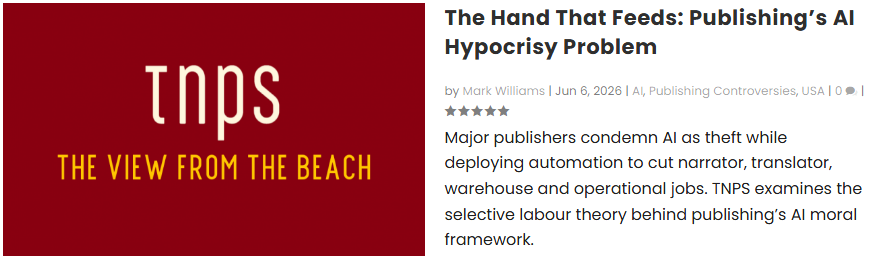
But no, don’t try suggest publishing cares about jobs. Per a recent TNPS Analysis, publishing is actively embracing AI to save money, and invariably that means cutting jobs.
The most automated hyperscale facilities – those exceeding 100 megawatts – can operate with as few as 20 to 30 permanent staff per 100 MW.
A May 2026 Brookings Institution study analysing approximately 770 US data centre facilities found that counties receiving their first large data centre see total private employment rise by 4 to 5 per cent over five to six years, with construction employment rising 11 per cent and information sector employment rising 22 per cent.
However, the long-term operational jobs created are substantially fewer than the construction phase suggests, and the tax incentives offered to attract data centres – Virginia alone forgave an estimated $1.6 billion in data centre tax in fiscal year 2025 – warrant scrutiny on a cost-per-job basis.
So yes: significant construction employment, real economic stimulus in host communities (particularly through property tax revenue, which in Loudoun County, Virginia now accounts for 38 per cent of the county’s General Fund), and a modest permanent operational workforce. Not a panacea, not negligible. And not mentioned by The Independent.
The Publishing Hypocrisy Problem
This is where the environmental argument meets the analysis set out in TNPS’s earlier examination of publishing’s selective AI ethics, per link above.
The publishing professionals sharing Independent articles about AI’s water footprint have a data centre problem of their own, and it is called Amazon.
But no, we can’t point the finger at Amazon as if we were in someway uninvolved.
Every Kindle download, every Audible stream, every KDP upload, every print-on-demand order routed through KDP Print runs on AWS infrastructure. AWS is approximately 32 per cent of global cloud computing.
When someone in publishing expresses horror at AI data centre water use, they are expressing horror at the infrastructure that delivers their own authors’ digital books to readers. The pipeline is the same. The servers are the same. The water is the same water.
There is also the conference problem.
Publishing is an industry that jets its leadership across hemispheres to attend book fairs in Frankfurt, London, Bologna, Abu Dhabi, and New York several times a year. A return flight from London to Frankfurt – for one of the industry’s shorter hops – produces approximately 600 kg of CO₂ per passenger. The long-haul flights, the hotels, the private dinners, the awards ceremonies: the environmental footprint of a major publisher’s conference calendar dwarfs, by any reasonable calculation, the energy cost of the AI tools their editorial teams are quietly adopting. The moral arithmetic here is not complicated.
And then there is the physical book supply chain, which is the most convenient thing the industry has ever collectively agreed not to discuss out loud in environmental terms.
Paper production for printing requires between 11,000 and 19,000 gallons of water per tonne. The US publishing industry is estimated to fell approximately 32 million trees annually. Yes, trees are renewable and some publishers take that side seriously. But energy and water are also renewable. It’s all about choices.
The return rate (remainders) in trade publishing runs at 20 to 30 per cent, meaning that between a fifth and a third of all printed stock ends up pulped or landfilled – approximately 640,000 tonnes of books in US landfills each year.
Traditional offset printing uses solvent-based inks that release volatile organic compounds.
A physical book produces 2.7 to 7.5 kg of CO₂ equivalent over its lifecycle. A digital book read on an existing device produces approximately 0.008 kg CO₂ equivalent – between 99 and 99.7 per cent lower, depending on the study.
The environmental argument for AI-assisted digital publishing, against traditional print, is overwhelming. It is simply not made, because making it would require an honesty that the industry’s current rhetorical posture is never going to permit.
Writing the Right Headline
The Independent article is not wrong that AI’s environmental footprint is real and growing. It is wrong to present that footprint as unique, unmanageable, or worse per unit of value delivered than the industries publishing already operates within and defends.
The Independent, desperate to appear independent and throughly modern, advocates abstinence to save the planet.
“The advice from experts is simple: Just use AI less often.
“The cleanest form of AI use is no use,” Kaveh Madani, a water scientist and director of the United Nations University Institute for Water, Environment and Health in Canada. “So when you could avoid using AI, don’t use it.”
Don’t use it for simple things. Don’t use it for calculations, directions, store hours, recipes or shopping lists, which are all searches people used to do without AI, but now do it with AI and waste power and water, Luccioni said.”
Oh, FFS! What a crock of shit!
Here’s the thing: We were either reading that article on paper, from a tree that was felled by a powered machine, transported to a mill to convert to paper, then transported a printer to smear with ink before being transported all around the country, to be used for one single day before being discarded. Or we were reading it online courtesy of data-centres and internet cables and not giving the environment a second thought.
The Independent managed to track down some choice click-bait quotes. Credit where due. But the right framing is regulatory, not abstinence-based.
We did not clean up the automobile by persuading people to stop driving. We mandated catalytic converters, then cleaner fuels, then tighter standards, then zero-emission targets – and the EU standards proliferated globally through market economics without requiring universal legislation.
The same pattern is available for data centres. The EU Energy Efficiency Directive, mandatory WUE and PUE disclosure, restrictions on potable water use in water-stressed regions, requirements for renewable matching and heat reuse: these are achievable, many are already in motion, and the industry’s efficiency trajectory – driven by the fact that energy is the single largest operational cost for any data centre – is moving in the right direction.
The publishing industry’s contribution to this debate should be honest accounting: of its own supply chain footprint, of its dependency on the same infrastructure it selectively attacks, and of the straightforward fact that digital distribution – including AI-assisted publishing workflows – is environmentally preferable to the alternative in almost every measurable dimension.
Instead, too many in the industry are sharing alarming articles about AI’s water use from devices currently streaming adaptations of their authors’ books, before flying to the next conference to warn about the robots.
That is not environmentalism. It is the green veneer on a commercial objection.
This post first appeared in the TNPS LinkedIn Analysis newsletter.