
While Western markets debate library relevance, the libraries of Southeast Asia are quietly redefining what a library is for.
The Wrong Conversation
Spend any time in Western library discourse in 2026 and you will find plenty of passion, plenty of urgency, and a remarkably narrow field of vision.
To be clear, the debates are real and they matter: funding cuts in the UK, politicised collection challenges in the US, digital access gaps in rural Europe. These are not trivial concerns.
But the almost exclusive focus on local crisis has produced a blind spot – a failure to notice that elsewhere in the world, many libraries are not fighting for survival. They are fighting for something far more ambitious.
Across Southeast Asia, a coherent, sustained and increasingly sophisticated movement is repositioning libraries as cornerstones of national development strategy.
The evidence is not anecdotal. It is institutional, governmental, and increasingly embedded in the policy language of the UN Sustainable Development Goals.
For us western publishing professionals in particular – in an industry that still tends to map “the future” along the North Atlantic – this movement deserves serious attention. The communities being shaped by these institutions are tomorrow’s authors, tomorrow’s markets, tomorrow’s global readers.
The story has been building for years. Most of the industry missed it.
Cambodia: Diplomacy Begins at the Shelves
It is worth starting with Cambodia, because Cambodia is, on paper, the kind of country that Western publishing has always been tempted to bracket as peripheral.
We’ve probably heard of it from the Vietnam War era, or remember it as Kampuchea from that dark interlude, but it’s just one of those distant somewhere-near-Thailand countries, where Thailand itself is only on our radar as a beach holiday destination.
That framing has always been wrong. And it is becoming harder to sustain by the month.
In January 2026, the Cambodian Librarians Association hosted a two-day international forum whose agenda would have raised eyebrows at any major Western library conference. The subjects under discussion included space power, library diplomacy, AI fluency and digital transformation.
The co-organisers included CamEd Business School. The supporting partners included the Italian Business Chamber Cambodia, and the European Union. Speakers came from Asia, Europe and North America. This was not a local professional development event with international trimmings. It was a genuinely multinational conversation, convened in Phnom Penh, on how libraries navigate geopolitical and technological complexity.
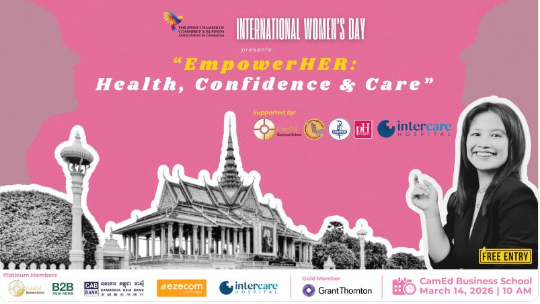
Six weeks later, the same association co-hosted EmpowerHER – a women’s financial literacy, health, and personal growth event – with PhilCham Cambodia, timed to International Women’s Day.
In February, it had brought nearly 500 participants together to explore libraries as drivers of environmental policy and climate action.
The cumulative picture is of an institution – or rather, a national professional association – that has fundamentally re-imagined its own mandate. Libraries in this reading are not custodians of collections. They are knowledge infrastructure: civic, diplomatic, developmental.
The Cambodia Book Fair, co-organised by the CLA alongside government ministries, has grown from ten exhibitor booths in 2011 to nearly 300 today. That is not the growth curve of an amenity. It is the growth curve of an industry the state has decided is important to sustain.
And an aside here – in 2025, 90,000 people attended the event. In 2022, 200,000. A downturn in the fair’s trajectory? Far from it. It was shift in priorities from quantity to quality.
The Philippines: Twenty-Two Years of Asking the Right Questions
In October 2026, the Ateneo de Manila University in Quezon City will host the 10th Rizal Library International Conference.

The conference is biannual, and its origins stretch back to 2002, when the Rizal Library co-organised an international seminar on e-publishing trends with the Association of Christian Universities and Colleges in Asia. The first full RLIC – themed “Library Management in the 21st Century” – ran in 2004. The institution has been asking serious questions about the future of libraries, professionally and publicly, for more than two decades.
The 10th RLIC’s theme is worth reading carefully: Reimagining Libraries with Innovation and Culture, Honoring Heritage, Shaping Intelligent Futures.
The language is not accidental. It is doing real analytical work. It holds together things that Western library discourse tends to treat as a trade-off – heritage and innovation, cultural rootedness and technological acceleration – and insists they are not in conflict but in dialogue.
The sub-themes of the conference extend that argument into detail. They span libraries as human-centred wellness hubs; sustainability aligned to the UN SDGs; digital hygiene and information integrity; cultural responsiveness and inclusive access; community engagement and heritage promotion; AI in the preservation of historical memory; and the ethics of national identity in a rapidly evolving digital landscape. This is a conference interrogating civilisational questions.
The call for papers deadline, BTW, is May 2026. The registration fee for international participants is $75. Worth every dalasi!
The keynote speakers reflect the conference’s reach. Caroline Pang, University Librarian at Nanyang Technological University in Singapore, brings 25 years of sector experience and sits on the Executive Board of the International Association of University Libraries representing the Asia Pacific region – as well as serving on advisory boards for Elsevier, EBSCO and Wiley.
Lourdes T. David, the founding architect of the RLIC itself, developed library training modules for UNESCO delivered across more than ten SEAMEO member states.
The third keynote, historian Ambeth Ocampo – 35 books published, the Philippines’ foremost public historian – is a signal of something important: that the conference understands libraries not merely as professional environments but as custodians of national narrative. Bringing a public intellectual of that stature to a library conference is a statement about what libraries are for.
The Regional Picture: CONSAL and the Scale of the Shift
Cambodia and the Philippines are not isolated cases. They are visible instances of a regional pattern that has institutional expression at the highest level.
In June 2025, the 19th Congress of Southeast Asian Librarians – CONSAL XIX – convened in Kuala Lumpur. It was the first in-person gathering in seven years, following pandemic disruptions. More than 1,200 delegates attended from across the region. Malaysia’s Prime Minister Anwar Ibrahim opened the congress, making explicit the links between libraries, democracy, creativity and social inclusion in the age of AI.
The theme was Inclusive Knowledge: Bridging Divides, Empowering All. The CONSAL XX flag passed to Singapore, host of the 2028 congress – a handover between two of the region’s most digitally sophisticated economies, which is itself a statement of ambition.
Let me stress that detail – a sitting head of government opening a library conference – not because it is diplomatically routine but because it is not. The presence of a Prime Minister at a gathering of librarians reflects a national-level understanding that knowledge infrastructure is strategic infrastructure.
That understanding is far from universal in the West, where the equivalent image – a Prime Minister or President opening a library conference – would be headline news for its novelty. In Kuala Lumpur in 2025, it was unremarkable.
Elsewhere in the region, the Southeast Asia Libraries of the Future Summit – organised with Elsevier and supported by Thailand’s Ministry of Higher Education, Science, Research and Innovation – held its third edition in Bangkok in mid-2025, focused on AI integration, sustainable collections, and digital access across the region’s academic libraries.
Academic research from Indonesia is framing library reach across 38 provinces explicitly as a governance and development question, tied to SDG outcomes and measuring community engagement as a policy variable. A separate Indonesian study has examined the strategic implications of mobile container libraries for smart society development.
These are not isolated professional development exercises. They form a picture of a region-wide upgrade – in ambition, in institutional positioning, and in the expectations placed on libraries by governments and communities alike.
The View From The Beach
There is a version of this story that stays inside the library sector. That version is interesting but not urgent for publishing professionals.
The version that should demand attention is this: the communities where library engagement is most sophisticated and most strategically embedded are precisely the communities that global publishing is only beginning to take seriously as markets. Southeast Asia’s reading public is young, digitally native, multilingual, and growing in both size and purchasing power.
The infrastructure being built around libraries in this region – community engagement, digital literacy, wellness programming, cultural preservation – is the same infrastructure that creates and sustains reading habits. The CLA’s Cambodia Book Fair trajectory, from ten stalls to 300 exhibitors in fifteen years, is a market development story as much as a library story.
There is also a content dimension to explore here. The 10th RLIC’s sub-theme on AI and the preservation of historical memory is a question that publishers – especially those working in academic, educational, and heritage publishing – will increasingly need to engage with.
How machine intelligence intersects with cultural sovereignty, with the authenticity of archival record, with the representation of non-Western historical narrative: these are not marginal concerns. They are moving towards the centre of the publishing industry’s own debates about what it produces and for whom.
I’m saying, then, that the conferences and associations discussed here are worth watching not as curiosities but as indicators. Libraries in Southeast Asia are leading where publishers in the region are likely to follow. The professional conversations happening at RLIC and CONSAL are shaping the information environment in which publishing operates.
A Different Kind of Relevance
The Western library debate, at its best, is a debate about relevance. Can the library remain essential in an age of digital abundance? Can it justify public funding when content is increasingly free or subscription-based? Can it serve communities whose needs have shifted from book access to social support?
These are legitimate questions. But they rest on a particular assumption – that the library’s original function, the lending of physical books, has been superseded. In contexts where that function was never taken for granted, where libraries were built in communities without reliable electricity or broadband, where a physical collection was never the beginning and end of the library’s value, that assumption does not hold. The library’s relevance was never primarily about the book. It was always about the space, the access, and the trust.
Southeast Asia’s library professionals did not need a digital disruption to teach them that. They already knew it. The result is a sector that, in 2026, is not defending a legacy model but building something new – and building it at a pace, and with a level of governmental engagement and intellectual ambition, that the West would do well to study rather than overlook.
The 10th RLIC opens in Quezon City in October. The conversations that take place there will be worth attending. For those who cannot make it, they will be worth following. Needless to say, TNPS will be watching from afar.
This post first appeared in the TNPS LinkedIn newsletter.